Another Incredible Weekend of Imaging
|
Due primarily to the incredibly dry air and clear skies, an ad-hoc three
day long star party was held at Area 51 Thursday, Friday, and Saturday
nights. The event was attended by approximately 15 people, but not
everyone was there all three nights. The viewing conditions were
spectacular, and each night one or more people stayed up till after
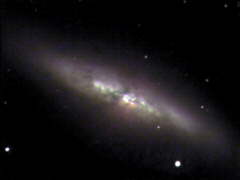
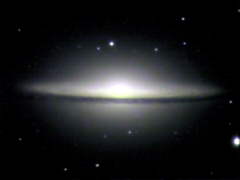
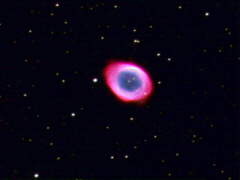
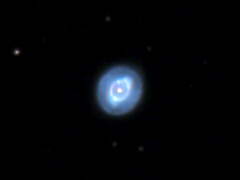
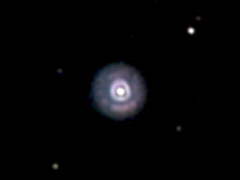
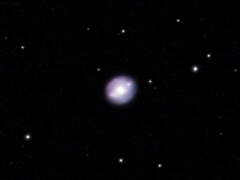
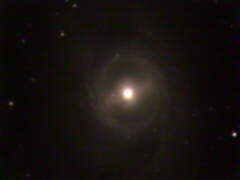
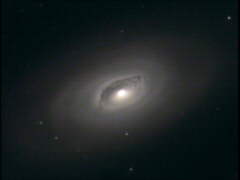
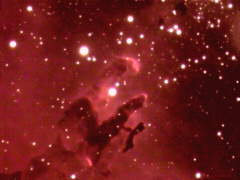
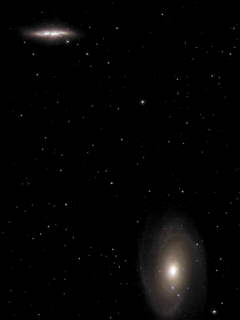
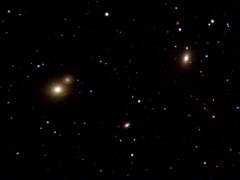
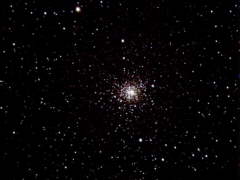
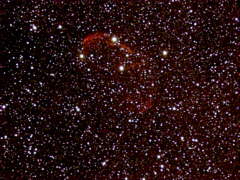
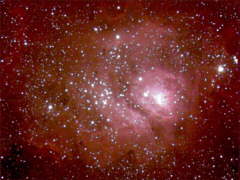
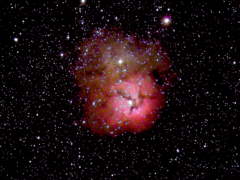
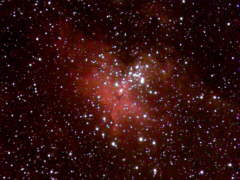
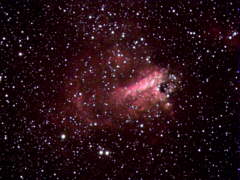
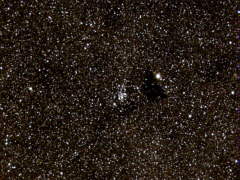
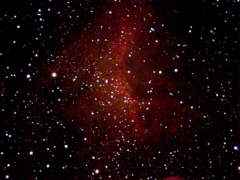
dawn. I attended all three nights of our little mini-starparty, and I must say that it was a great event in spite of the complete lack of planning or scheduling. The main reason for this is, of course, the great weather. I had my scope set up for imaging all three nights, and I bagged a total of 23 objects with my camera. A powerful cold front passed during the early morning hours on Wednesday, and by Thursday night, the wind had subsided and we were submersed in a large dry air mass. I arrived on the scene just after sunset to find two scopes already set up for viewing. I hastily assembled my tripod, wedge, and scope during the fading twilight and was ready for polar alignment just as Polaris was becoming visible in the night sky. I carefully computed the angle and position of the pole with respect to Polaris, and I was quickly able to position my scope directly on the target. Since I had been planning to image at f/10, I decided to check my alignment with a drift test. To my great dismay, any chosen star would drift significantly within the timespan of just a couple of minutes. I was certain that I had done a good polar alignment, so I immediately assumed that the software in the telescope was in a confused state. I shut down the scope, waited for a few seconds, then reapplied power and went through a simple alignment procedure. Unfortunately, a second drift test produced identical results to the first one. This was very confusing to me, so once again I shut down the scope and re-aligned the polar axis to True North. When power was restored to the scope, the drift error persisted. By now, I was really getting my feathers ruffled, so I called the other two fellows over and asked them for assistance. Since they were both old DOBers, surely their knowledge of the sky could solve my problem. Unfortunately, fork-mounts were well outside of their area of expertise, and I still could not resolve my dilemma. This rather infuriating situation continued till almost 11PM, when eventually the rotation of Polaris around the celestial pole finally shocked me into the realization that I had been aligning on the wrong side of the star, exactly twelve hours off the desired target. I quickly repositioned the scope, completed a successful drift test, and settled back in my viewing chair to cool my frazzled corpuscles. I have never made that rather stupid mistake in all my many years of astronomy. I wondered aloud if I was beginning to loose my mind. I'd be willing to bet the other two astronomers were certain I already had. Friday night I arrived just before sunset, only to find that once again there were two others already set up for viewing. Things went much better for me than the previous night, and I imaged eight objects by the time the morning twilight brought a end to my nighttime endeavour. One set of images was unprocessable for reasons that still elude me. The other seven pictures are shown below. Saturday night was the best of all, not because the weather was good (it wasn't) but instead because of the large turnout of people and the variety of telescopes. In an attempt to be a bit more sociable in the larger crowd, I set up my scope for wide field imaging so everyone could come by and check out what was going on from time to time. By the time dawn came around, I had collected twelve sets of images, only one of which was not worth processing into a picture. The weather was more or less great the entire weekend, with clear skies, dry and still air, and very few mosquitoes. We suffered a spat of thin but obscuring clouds on Saturday night alone, and it caused several people to become frustrated and many of them prematurely packed up and headed for home. Almost exactly on que with each vehicle's departure, the clouds would vanished for about 15 minutes. Finally, at 2 AM when Ron D'Oria disassembled his 18" Starmaster, the clouds completely went away and did not return the rest of the night. Fred Lehman, April 18, 2004.
| |||||||||||||||||||||||||||||||||||||