Twelve Hours in the Glades
|
Sunday afternoon was warm and dry and the sky was filled with small puffy
clouds. The wind was brisk but steady, and my intuition told me that the
evening and nighttime were going to be nearly perfect for imaging. I knew
that I would be alone all night out in the Glades, so I decided to take the
minivan with the camp trailer in tow. Although it's a small camper,
it has a full complement of creature comforts, including a full sized PC
with an 18" display, 5-point surround sound, and an ethernet link to my
laptop.
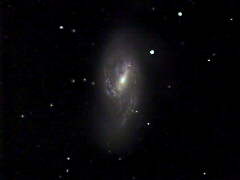
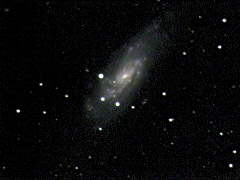
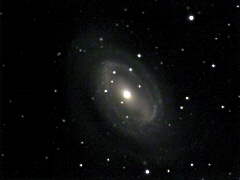
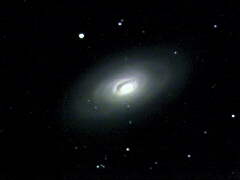
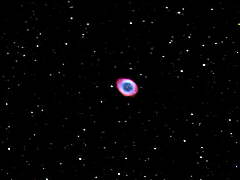
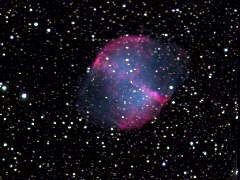
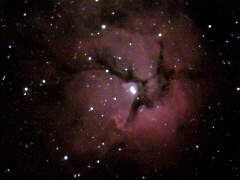
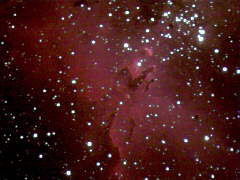
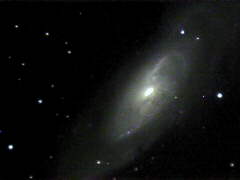
Just as I left my driveway, I noted that the clock read 7:00 [pm] and I wondered aloud if I would be back home before the clock read 7:00 [am] once again. Towing the camper limits my cruising speed, but I was in no hurry tonight. The early crescent moon would not be setting till almost 10:30, and I was planning to make dinner out there anyhow. My short journey proceeded as expected right up until the final moment. As I approached the end of the line where I normally set up my scope, a big old alligator was sitting there right in the middle of the road. I blew the horn and flashed the headlights, hoping to scare him back into the creek where he belongs. To my great dismay, instead of rushing to the protection of the water, he scrambled off in the other direction, up and over the berm and into the bushes and the tall sawgrass beyond! I sure hope he's planning to spend the night over there. Although the optics on my scope have always been quite good, I have never been completely satisfied with its tracking. For visual purposes, almost any tracking at all is adequate, but for imaging the tracking must be nearly perfect, and mine wasn't. Unguided images were all but impossible, and even the most nimble of the autoguiders had to struggle to keep the tracking error under three arc seconds. The obvious result, of course, has been oblong stars and smeared nebulae. The various fancy deconvolution algorithms in modern astro-imaging software packages provide some relief, but there is really no substitute for good tracking. Some weeks ago I had purchased a replacement RA drive motor and gearbox assembly and tonight it was going to get its first test. While the scope was still in the back of the van, I carefully unscrewed the base plate, then unplugged, unbolted, and removed the drive unit. Reversing the procedure, I installed the new gearbox and replaced the base plate. The entire operation was complete in under 5 minutes. I quickly tossed the scope onto the waiting mount, hooked up the cables, and threw the switch. Initial checkout was done by simply pushing the East/West controls and listening for any sounds out of the ordinary that would indicate that things were binding up or not running smoothly. No problems were found at this stage, so I manually pointed the scope at Jupiter and locked down the clutches. Viewing through a high power eyepiece, I could immediately tell that on the fine detail at least, the new drive was silky smooth. The final test would come only when the autoguider was in place. I will then get a full numerical readout of the total tracking error, fast and slow. Twilight lingers noticeably longer as summer approaches, and I found myself growing impatient before it was dark enough to start shooting. I tried to occupy myself by cooking up a good Sunday evening dinner, but my mind kept wandering back to my scope. I ended up sort of gulping everything down so I could get back out there to test my new RA drive. After a rather abbreviated session of washing the dishes and tidying things up, I jumped out of the brightly lit camper and into the darkness. Presently, I forgot all about my telescope, as the only thing on my mind now was that big old alligator. With no night vision, he could have been two inches from my toes and I wouldn't even have been able to see him. I immediately jumped back into the camper and turned off all the lights. After a minute or so, my breathing and heart rate were back to normal, so I turned on the red lights more suitable for nighttime astronomy. This time I opened the door just a crack and carefully peeked out to see if the coast was clear. The sandy road looked uniformly light with no long fat dark patches, so I slowly stepped out and scanned the area with the brightest of my red flashlights. There were no shiny eyes to be seen, neither in the grass nor up and down the road, so I cautiously proceeded on to my scope. Blindly leaping out into the darkness had been a rather unnerving experience, and I realized that I would be on edge all night over this alligator, with every unusual sound sending a startling chill up my spine. Final alignment was quick and easy, and soon afterwards my scope was pointed at M66 and I was taking my first set of images. The new drive unit performed well, and in fact, it seemed to have only about one tenth the tracking error of the original unit. Even near the celestial equator the autoguider could easily keep things on track within a half an arc second, and most of that error can be pulled out with proper training of the periodic error correction circuitry. I really wish I had replaced the drive five years ago when I first noticed the problem. Meade service should have advised me to do so when I called them about it after trying to take pictures with my Nikon film camera. Instead they had all sorts of crazy excuses and even a few reasons why it should actually work just that way. At their suggestion I bought a Meade Pictor CCD camera and a Meade off-axis autoguider. Both proved to be completely worthless. Next, I slewed to NGC4559 and began to capture another sequence of images. Soon, a small clump of low lying clouds set in, so I covered up the scope and started shooting dark frames. The clouds passed in only a half an hour, so I then proceeded on to NGC4725. After almost a hour of complete clearness, a small patch of clouds once again covered the sky. I had plenty of dark frames, so I went into the camper to consult the star charts and pick my next target. It cleared up again in only 15 minutes, so I pointed the scope at the Black Eye Galaxy (M64), and once again started imaging. A half an hour collects enough light from a nearly featureless object like M64, and I was growing tired of galaxies anyhow. It must be about time to move on to the much more colorful nearby nebulae. The first Milky Way object high enough to image was the Ring Nebula (M57). Unfortunately, after only 20 minutes of imaging the Ring, I noticed that things were beginning to get wet. It was now time to de-fog the corrector plate, install the dew shields, and turn on the dew heaters. Not wanting to completely waste the time while things were drying off, I covered the main aperture and clicked off another sequence of dark frames. Twenty minutes was enough to drive away all the accumulated dew, so I uncovered the scope and captured my best images yet of the Dumbbell Nebula (M27), followed closely by the Trifid Nebula (M20), and finally the Eagle Nebula (M16) with its famous EGGs (Evaporating Gas Globules). The pre-dawn twilight was beginning to kill the darkness in the northeast, so I covered the main scope and squeezed off four more dark frames while breaking down and putting things away for the trip home. I felt tired but happy on the long drive home. Sunrise occurred about half way back, and the bright early morning light seemed somewhat annoying after so many hours of such fine darkness. The clock clicked over to 7:00 [am] just as I pulled into the driveway, twelve hours to the minute from the time I left. I never did find out where that alligator went. Fred Lehman, May 4, 2003.
| ||||||||||||