| Object Data |
| Description |
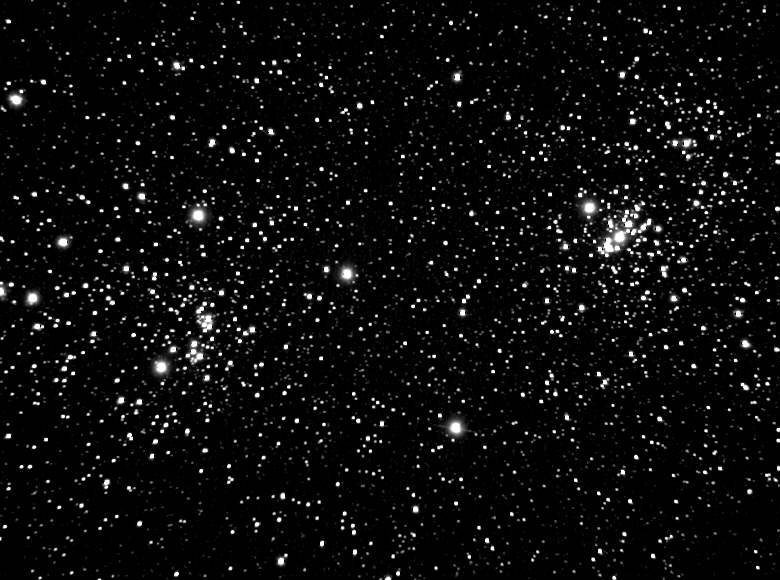
The famous double cluster in Perseus was known in
ancient times, and was first cataloged by the Greek astronomer Hipparcos.
Both clusters are situated in the Perseus OB-1 association and are both
quite young (5.6 and 3.2 million years). Their hottest main sequence stars
are of spectral type B0. |
| Constellation |
Perseus, the Rescuer of Andromeda |
| Right Ascension |
2h 20m 59s |
| Declination |
+57° 9' 6" |
| Magnitude |
4.3 & 4.4 |
| Angular size |
58 arcminutes (both clusters together) |
| Distance |
2.25 kiloparsecs (7,300 light years) |
| Radial Velocity |
-40 kilometers per second (approaching) |
| Image Data |
| Photographer |
Fred Lehman |
| Main Scope |
Meade 14" LX200GPS |
| Imaging Scope |
Celestron 5" SCT @ f/3.3 (415mm) |
| Guide Camera |
Not needed |
| Imaging Camera |
Starlight Xpress MX7C |
| Resolution |
780 x 580 @ 1.44 arcseconds per pixel |
| Exposure |
Thirty exposures of 10 seconds each. Aligned,
stacked, and processed with AstroArt. |
| Date |
January 16, 2004 |
| Location |
Area 51 in Big Cypress National Preserve in
central South Florida. |