| Object Data |
| Description |
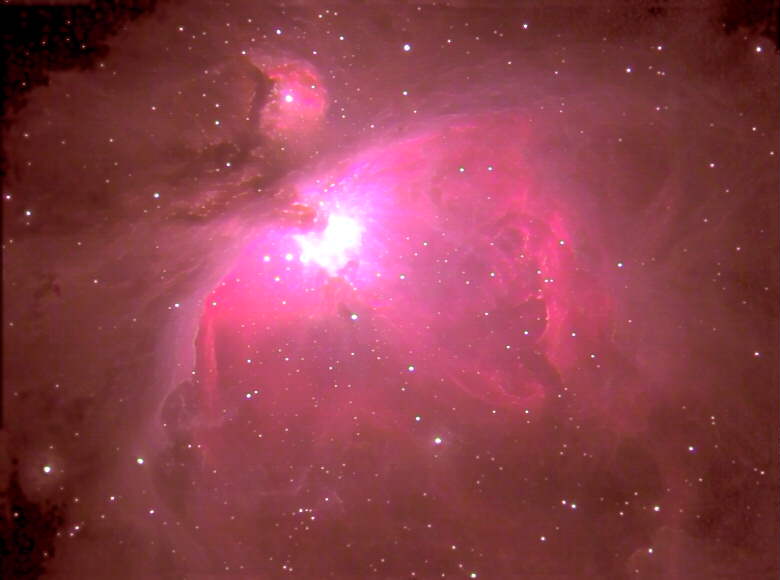
The Great Orion Nebula is the most famous nebula in
the night sky, and also one of the brightest. Its beauty can be admired
through the eyepiece of any size of a scope, even a pair of binoculars will
suffice. |
| Constellation |
Orion the Hunter |
| Right Ascension |
5h 35m 40s |
| Declination |
-5° 27' 53" |
| Magnitude |
4.0 |
| Angular size |
1.5 degrees |
| Distance |
490 parsecs (1,600 light years) |
| Radial Velocity |
32 kilometers per second |
| Image Data |
| Photographer |
Fred Lehman |
| Main Scope |
Meade 14" LX200GPS |
| Imaging Scope |
Celestron 5" SCT @ f/3.3 (415mm) |
| Guide Camera |
Not needed |
| Imaging Camera |
Starlight Xpress MX7C |
| Resolution |
780 x 580 @ 4.1 arcseconds per pixel |
| Exposure |
Ninteen exposures of one minute each. Aligned,
stacked, and processed with AstroArt. The central portion of the
nebula around the Trapezium has been deliberately overexposed to
reveal subtle structure in the darker surrounding portions of the
nebula. |
| Date |
January 16, 2004 |
| Location |
Area 51 in Big Cypress National Preserve in
central South Florida. |