| Object Data |
| Description |
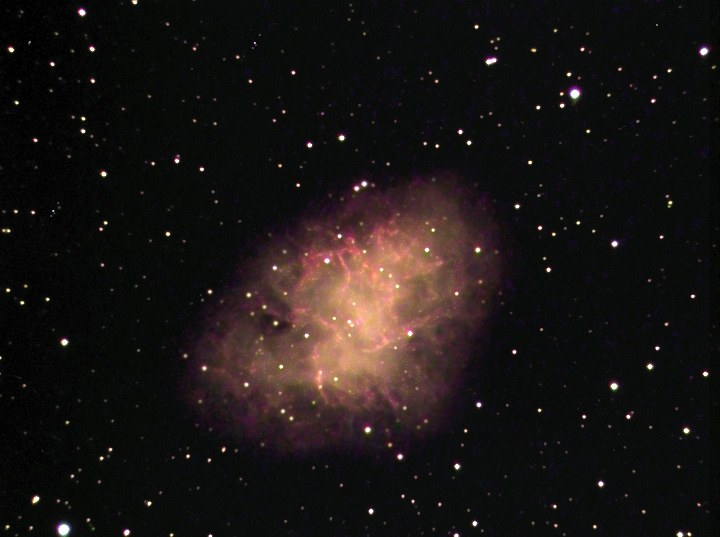
The Crab Nebula is a supernova remnant from a giant
star that suffered a catastrophic core collapse on July 4, 1054, almost a
millennium ago. The enormous amount of electrical power needed to light up
this structure comes from the rotational energy of a tiny stellar cinder
called a neutron star, which is located near the center of the nebula and
is spinning at thirty times per second. With its trillion gauss magnetic
field, this rapidly spinning neutron star effectively becomes a 30Hz
electric generator, inducing a tremendous current into the highly
conductive surrounding plasma. The ionized gas is heated to millions
of degrees, where it radiates prodigiously in the X-ray and extreme
ultra-violet portions of the spectrum. The outer reaches of the nebula,
which are bathed in the ultra-violet from the core, re-radiate in the
visible spectrum much like a conventional household florescent lamp.
Although it is quite beautiful in photographs, it is difficult to discern
any detail in this object with a small telescope. |
| Constellation |
Taurus the Bull |
| Right Ascension |
5h 35m 12s |
| Declination |
+22° 2' 7" |
| Magnitude |
8.4 |
| Angular size |
8.0 arcminutes |
| Distance |
1.8 kiloparsecs (5,800 light years) |
| Radial Velocity |
?? kilometers per second |
| Image Data |
| Photographer |
Charlie Warren |
| Main Scope |
Meade 10" LX200 GPS @ f/7 |
| Guide Scope |
None |
| Guide Camera |
None |
| Imaging Camera |
Starlight Xpress MX7C |
| Resolution |
720 x 537 @ 1.0 arcseconds per pixel |
| Exposure |
Forty exposures of one minute each. Aligned, stacked,
and processed with AstroArt. |
| Date |
February 28, 2003 |
| Location |
Mid Florida StarGaze at Fish Eating Creek Campground
in Glades County, Florida |