A Very Short Session
|
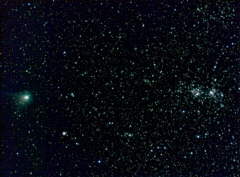
Even though the moon was full on Tuesday, I bugged out of work an hour early
Wednesday afternoon and drove out into the Everglades to capture the comet as
it made its closest approach to the Double Cluster in Perseus. The sky wasn't
dark enough for imaging till 7:05 PM, and the moon poked its nose above the
horizon at 7:16 PM. Within that somewhat narrow time window, I captured
12 minutes worth of photons, which is just about right for this comet at
the magnification factor needed for this picture. The field of view is
7¼° wide by 5½° high, with North up and East to the
left. Both the comet's tail (heading SouthSouthEast) and its ion stream
(heading East by North) are just barely visible. The double cluster can
be found on the opposite side of the photo, with NGC884 immediately to the
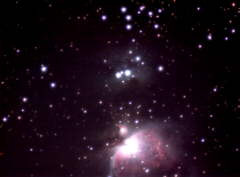
left of NGC869. Even though the full moon was now high in the sky, I could not resist the urge to capture a wide-field shot of the Orion Nebula. The sky was getting quite bright, so the picture is a bit washed out with poor detail in the dimmer areas. I wanted to show the Running Man Nebula in perspective with M43 and M42, although next time I will center things a bit better. The FOV is 1¾° wide by 1¼° high. This is the result of only twelve minutes of exposure, so in addition to being washed out from the moon, the picture is a bit grainy. I am a bit puzzled by the bright stars that appear to have five points on them as if they were drawn by some young child with a dull marker. Still, any picture of the sky is better than no picture at all. I don't think there has ever been a time before this when I have set up all my equipment, only to tear it all back down again after only a half hour of imaging. The worst part is that the sky was perfectly clear, with no haze and no clouds at all. The stability was quite good as well. I wish these conditions would occur when the moon wasn't full. It feels very strange to be home by 9 PM. Fred Lehman, January 26, 2005
|