A Weekend of Imaging
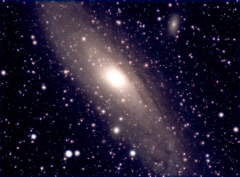
Friday January 7, 2005There were six telescopes and eight people at the site on Friday night. Although the comet was in a favorable position for photography, the sky conditions were not. The humidity was high and the atmosphere was murky. After three hours of fooling around and trying an assortment of techniques, I was finally able to capture a mediocre image of the comet and the Pleiades. It is always an uncomfortable compromise to simultaneously capture a dim object and a bright one in the same field of view. I have not yet mastered the fine art of taking separate images of each of the two objects and then combining them into an unrealistic but nevertheless pleasing result. After the comet, and since I was already set up for the proper field of view, I turned the scope to Andromeda to catch a few minutes of M31 before the clouds took over once again.
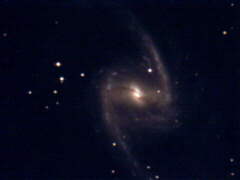
Saturday January 8, 2005The attendance on Saturday night was much better, with 18 people bearing fourteen telescopes. There were three 18" DOBs (two with GOTO), my 12" LX200, three 11" NexStars, and a handful of scopes of lesser aperture. The smallest scope was a 39mm f/5.6 mounted on a very short tripod with a motorized equatorial head. He was capturing amazing wide-field photographs (20 degree FOV) in the gaps between the clouds.The evening started out perfectly clear, but haze soon took over the sky and dominated the scene. Since the haze was coming from the north, I turned to the south and trained my scope on a marvelous barred spiral in Fornax. The haze was advancing rapidly, and I only captured twenty-eight minutes worth of photons before it was swallowed up beyond recognition. The haze and its associated turbulence made the stars big and fuzzy and blurred out both the details and most of the color, but this the object makes up for my shortcomings with its incredible beauty. Later in the night I tried to image an assortment of other objects, but I was unable to get enough integration time to make a worthwhile picture. Visual observations were still possible in the holes between the clouds, and the last of us stayed till after 3AM.
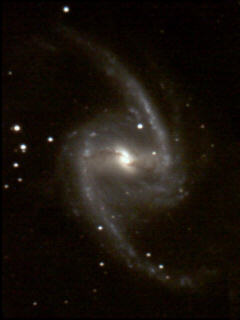
Sunday January 9, 2005Sunday night is alway a tough one for attendance, and this Sunday was no exception with only three attendees. The weather was the best of all three nights, with clear stable skies and a nearly complete absence of haze. I was quite tired from the previous two nights of imaging, so I had to cut the evening short so I could get enough sleep to be functional at work on Monday.As I was setting up my scope, a minivan containing a family of seven non-astronomers appeared on the scene. The parents patiently watched me put all my equipment in place while the children threw rocks at the alligators. I took a few minutes to show them several interesting objects in the waning twilight, and they were soon on their way. I then converted my scope from visual mode to photographic mode, an operation that is much more difficult than it seems. I concentrated my entire effort towards re-shooting NGC1365 under the more favorable sky conditions. It's very peaceful out in the darkness and I really wanted to stay all night, but I must still keep my day job, so I reluctantly packed up and headed for home at midnight.
|