The First Truly Good Night of the Winter Season
|
This past summer has been the worst ever for viewing and photographing the
sky. We have suffered three major hurricanes, and it has been cloudy, rainy,
and hazy ever since mid May 2004. I seem to remember one clear day in all
these months, but as chance would have it, the nearly full moon would have
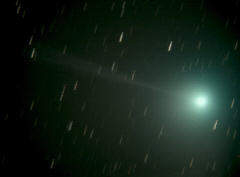
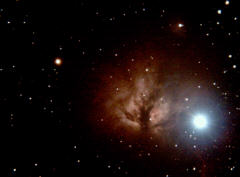
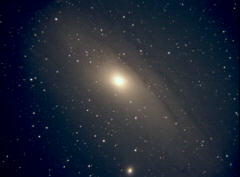
spoiled any chance of viewing. A first-time comet was approaching and rapidly brightening in the evening sky. It was scheduled to make its fly-by of the Earth on Friday the seventh, at which time it would be only two degrees from the beautiful Pleiades cluster. I had purchased a new camera way back before Christmas, and I was itching to try it out in the darkness for almost a full month. Although it was a Monday night and I had to be at work on Tuesday morning, the sky was clear and the comet was bright and the moon would not rise till almost midnight, so I loaded up my equipment and headed out into the Everglades. I didn't get out there till well after sunset, and I immediately set up my table, chairs, and tripod. However, it felt so strange to be under clear skies again after so many months of complete deprivation that I just sat in my chair for a full half hour, not completely believing that the situation was anything more than just a dream. Eventually, the accumulating number of mosquito bites on my legs and arms convinced me that this was all really happening, so I continued with the setup of my telescope. I started sequencing the comet just before 9:30 PM, and by 10 o'clock I had captured enough photons to make a good picture, so I chased around the sky, taking snapshots of a variety of objects, not to get usable pictures but simply to check out my new camera and a few new techniques. One of the key features of the Sony Super-HAD CCD is that it is oblivious to over exposures, regardless of how long of an integration time you use. To give this feature a proper test, I aimed the camera at the Flame Nebula with the second magnitude Alnitak well into the field of view. This would be a foolish endeavour with an ordinary CCD camera, because the bright star would saturate the chip and render the photo useless long before enough photons were collected from the nebula to make it visible. Shooting at f/3.3 (very bright), I gave the pair a single four minute exposure. The results were most pleasing, with the image of the Flame clearly visible yet the star was not unreasonably not burned out. Next, I slewed the scope to the Andromeda Galaxy, and I captured a short sequence to test out the color discrimination. This experiment also produced pleasing results, even though I did not give it enough integration time to get a really good picture. By now the moon was killing the darkness, so I packed up my things and headed for home. All in all, a pleasant and rewarding evening. Fred Lehman, January 3, 2004.
|