An Evening of Viewing
Since the Mid Florida Star Gaze was less than one week away, I decided to
commit an unnatural act and set up my scope for viewing rather than
imaging. It seemed as if we were going to have a rather modest turnout,
and I have always felt a little uncomfortable and even a bit anti-social
while imaging in a small group of astronomers. I will be imaging for the
entire duration of the Star Gaze, and it wouldn't hurt me too much to
actually look at some of these objects once in a
while.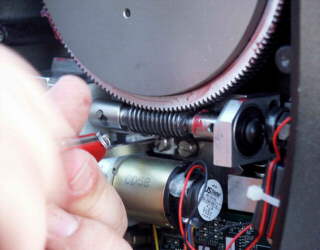
 The declination drive on my scope had been loose for several weeks, and
the problem had been getting increasingly worse with time. There was
still plenty of twilight, so I dismantled the drive unit to determine
the nature of the problem. Once disassembled, I discovered that the
single screw that attaches the gearbox to the mounting scissors had
worked itself loose and had fallen out of its hole and was lodged into
a crevasse at the bottom of the housing. Luckily, when it fell out it
did not jam itself into the worm gear. I quickly retrieved the screw
and tightened into place. I replaced the dust cover and was ready for
viewing well before the impending darkness settled in on us.
The declination drive on my scope had been loose for several weeks, and
the problem had been getting increasingly worse with time. There was
still plenty of twilight, so I dismantled the drive unit to determine
the nature of the problem. Once disassembled, I discovered that the
single screw that attaches the gearbox to the mounting scissors had
worked itself loose and had fallen out of its hole and was lodged into
a crevasse at the bottom of the housing. Luckily, when it fell out it
did not jam itself into the worm gear. I quickly retrieved the screw
and tightened into place. I replaced the dust cover and was ready for
viewing well before the impending darkness settled in on us.As it turned out, I was incorrect in my estimate of how many people would show up. By nightfall, we had 11 telescopes and 14 people at this rather hastily organized viewing session. The monthly viewing at JD Park had been canceled due to a Park Service party, so several of the regular members had followed me out into the Everglades instead. We had quite an array of scopes, four of which were larger than 12", including two 18" DOBs. The sky was clear and stable for the first couple of hours after sunset, but as the temperature continued to fall, thin clouds formed in the lower atmosphere at the crests of the waves between the two lowest layers of air. The cloud bands would haze up the sky for 15 to 20 minutes, after which it would get perfectly clear for an equal length of time. There was very little turbulence during the intervals of clearness, but each successive cloud band was a bit thicker than its predecessor and lasted a bit longer. By 2 AM, the cloud bands had turned into a continuous sheet, and it looked as if they might be thick enough to drop a little rain on us. Ron D'Oria and I were the last two to pack up and head for home, and I finally crawled into bed just before 4 AM. Fred Lehman, March 13, 2004. |