This was the first DuPuis session of the autumn season, and it turned
out to be a good one. The skies were about as dark as they can get,
and the light bands of high haze were only a minor distraction. We
had planned to set up our scopes at the old disused airstrip, but
much to our dismay, a fire had burned through the that segment of the
preserve only one day before. Although there was no smoke in the
immediate area, the freshly burned grass was rich with loose black
soot. Since none of us had a strong desire to get our clothing and
our equipment covered with soot, we proceeded on down the road to
the shores of a large lake in the southwestern corner of the
preserve.
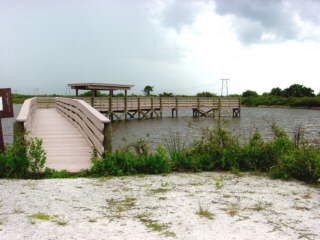
 The beauty of this spot was as unexpected as it was stunning. Although
the high voltage power lines on the far side of the lake are a definite
negative to the daytime scenery, they did not hamper the nighttime
viewing. As expected, we were accosted by a large flock of mosquitoes
just after sunset, but a gentle evening breeze picked up after twilight
and reduced the pests to an acceptably low level.
The beauty of this spot was as unexpected as it was stunning. Although
the high voltage power lines on the far side of the lake are a definite
negative to the daytime scenery, they did not hamper the nighttime
viewing. As expected, we were accosted by a large flock of mosquitoes
just after sunset, but a gentle evening breeze picked up after twilight
and reduced the pests to an acceptably low level.
The turnout for the evening was quite good, with five telescopes and
ten people, including 2 wives, one teenage daughter, and one random
passer-by. My scope was set up for imaging, and I spent almost the
entire evening capturing multiple overlapping exposures of the Great
Andromeda Galaxy (M31) to be pieced together later into a
mosaic.
After completing a full set of sequences on M31, I turned my scope to
a variety of southerly objects. Unfortunately the light southerly wind
that was so effective at reducing the mosquito population was also quite
effective at jostling my telescope to and fro several dozen arc-seconds.
It seems that a large dew shield also functions quite well as a large
wind scoop.
After a bit of frustration with southerly objects, I turned my scope to
the East to pick up the Orion Nebula. The wind scoop (dew shield) was
slightly off the axis of the wind in this direction, and by now Orion
was adequately high in the sky for imaging. The resulting picture is
without a doubt the most striking image I have ever captured, possibly
even good enough for an astronomy calendar page. The central portion
around the Trapezium has been deliberately overexposed to bring out
the subtle detail in the surrounding nebula.
The early third quarter moon drowned out the stars right on schedule at
10 PM, so with little delay, we packed up our equipment and headed for
home. For me this is a slow and painstaking process, but several of the
other attendees were most gracious and waited patiently for me to put
everything away so we could all drive out together.
Fred Lehman, December 13, 2003.
| Click on image to enlarge |
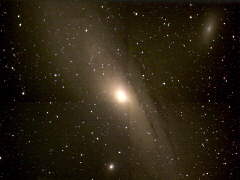 NGC224 - M31
Andromeda Galaxy
|
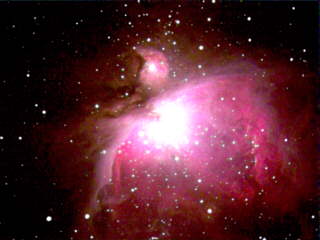 NGC1976 - M42
Great Orion Nebula
|
|