A Cheeseburger in Mosquitoville
|
Friday afternoon saw a few clouds developing over the deep Everglades, so
I opted out for setting up at the Sawgrass Recreational Park much nearer to
town. The sky is not too good in the East towards the city, but there are
absolutely no lights to the West, North, or South. The sky was clear, the
air was stable, the wind was light, and the mosquitoes were ferocious. After
applying nearly an entire spray can of DEET to my arms, legs, and back, they
were still biting me through my thin leather moccasins. While typing at my
laptop computer with my elbows bent, they were able find tiny gaps in the
repellent where the skin was stretched somewhat and they would attack me there
too! Also, although my long shaggy hair protects my neck, cheeks, and ears,
they would crawl under the hair on the top of my head and drill into my scalp.
I had the distinct feeling of being a juicy cheeseburger, sizzling on the grill.
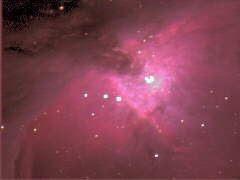
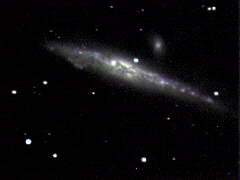
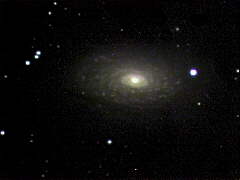
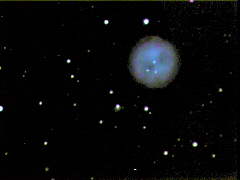
Setup went rather quickly in spite of all the bugs, or maybe actually because of all the bugs, and I was ready for alignment before it was dark enough to pick out Polaris in the pale cerulean blue sky of the fading sunset. I used this time to start up my small generator and hook up a portable battery charger to keep things from going dead before morning. The combination of the LX200, the laptop computer, the Starlight Xpress camera, and the STV autoguider produces a significant draw. If I have to use a dew heater or hair drier, the situation gets ever worse! In spite of its noise, the generator is an acceptable remedy for me, because it is hard to find a more frustrating way to ruin a good night of imaging than to loose power at 2 o'clock in the morning when you are too tired to do anything about it. My first target for the night was the Great Orion Nebula. I wanted to get a significant number of very short exposures so they could be stacked and processed to show off both the subtle detail in the darker sections and the beautiful structure surrounding the four very bright Trapezium stars. The contrast between these two areas is extreme, and it takes a very large signal to noise ratio in the source image to allow sufficient stretching to accomplish this feat. Even though I am not a superstitious man, I sometimes believe that more than anything else, it takes a good deal of luck to accomplish anything at all out there in the darkness with all this complex high tech equipment. It appeared at first, however, that good fortune was in the cards for me this night. The imaging software in the laptop computer reported that it could not link up with the camera. I disconnected and reconnected each and every one of the many plugs and jacks several times in succession, but the same dumb error message would reappear each time I tried to take an image. After a half hour of frustration the situation was approaching madness. I was now sweating profusely, and the sweat was washing away my mosquito repellent, with obvious consequences. As an act of desperation, I turned off my computer, disconnected all the cables, and put everything back in their carrying cases. After a short cooling down period which I used to wipe the sweat off my arms and face and apply the last of my bug spray, I once again took the laptop out of its case, hooked up all the cables, and turned it back on. Miraculously, this time everything worked perfectly! I have no idea was was wrong on the several previous attempts. I felt that I was running out of time to shoot Orion while it was still high enough in the sky, so I immediately entered "M42" on the LX200 hand controller and hit the "GOTO" button. The scope performed flawlessly, and a quick snapshot with the camera showed the nebula properly centered for imaging. Since I was going to take several dozen individual images, I wanted the autoguider engaged to eliminate any drift that would otherwise occur during the process. I took a short image with the STV and selected one of the bright stars just below the Trapezium as my guide star. I punched the "Track" button on the STV, and it almost immediately started beeping at me while displaying a tracking error message on the screen. It is difficult to adequately describe the sinking feeling that came over me as I repeatedly pushed buttons and turned knobs, all to no avail. After about twenty minutes of searching, I discovered that the cable that runs from the STV to the LX200 was slightly damaged on one of its ends. I have no idea how this could have happened, because I am always very careful with all of my equipment, and nobody else even as much as touches any of my expensive toys. I replaced the faulty cable with a spare and that was the end of my problems for the rest of the night. As they say, "Sometimes you're the dog, and sometimes you're the hydrant". I guess that it had just been my turn to be the hydrant for a while. The imaging of M42 went off without a hitch, and I was soon searching for another target. NGC4631 seemed a likely suspect, so I poked it in to the LX200, clicked on the autoguider, and set up the computer for a half-hour sequence of two minute exposures. There appeared to be a bit of haze in the high atmosphere, but it was so feeble that it would not have been noticeable at all if it were not organized into weak bands. I didn't think that there would be any adverse affect from such insignificant high-level clouds, so I simply turned on the radio in the van to drown out the constant buzz of the mosquitoes and sat back in my chair to relax. If you don't have some music to listen to, this imaging stuff gets really boring in a hurry. Luckily, I was still not too far from town to pick up my favorite "Oldies" station. My next target was only a short hop away to M63, the Sunflower Galaxy. Everything went smoothly there, so less than an hour later I was setting up on M97, the Owl Nebula. At magnitude 12, it is the dimmest object in the Messier catalog. Unfortunately, there is a magnitude 7 star in the same field of view, so a long exposure can't be used without saturating the CCD. Two minutes brought the star up to about 48,000 counts, so I grudgingly set up the computer for a one hour sequence of them. At least I could double up on the dark frames. Less than half way through imaging the Owl, the STV autoguider decided to send the scope chasing across the sky instead of keeping it in one place like it's suppose to. By now it was well past 1AM, and my mosquito repellent was wearing thin. The mosquitoes themselves were still quite active, but my spray can of DEET was completely empty. I felt that I had endured enough abuse for one evening, so I packed things up and headed for home. The rear hatch of the van had been wide open all night while I was listening to radio, so there were several hundred mosquitoes inside the van waiting in ambush. I drove home with all the windows open, but that only got rid of half of them. The rest will remain trapped in the van and end up dying an agonizing death in the heat of the daytime sun. I will exact my final revenge in a couple of days when I suck up their desiccated little corpses into the vacuum cleaner. Fred Lehman, April 4, 2003.
| |||||||||