
Full screen image
Full size image (1200x1600)
|
Meade Pictor with all accessories in Meade carrying case. Although
superficially this looks like a nice clean package, in reality it was a
complete disaster. The mechanical shutter was awful, the CCD chip was
terrible, the SCSI interface was awkward and clumsy, and the software was
nearly unusable. The whole system crashed repeatedly, requiring a complete
shutdown of both the computer and the camera, followed by a sequenced
power-up cycle. I never did get the autoguider to work at all. After two
years and many, many frustrating nights, I ultimately sold it on Astromart
to some other poor unfortunate sole. Full screen image Full size image (1200x1600) |
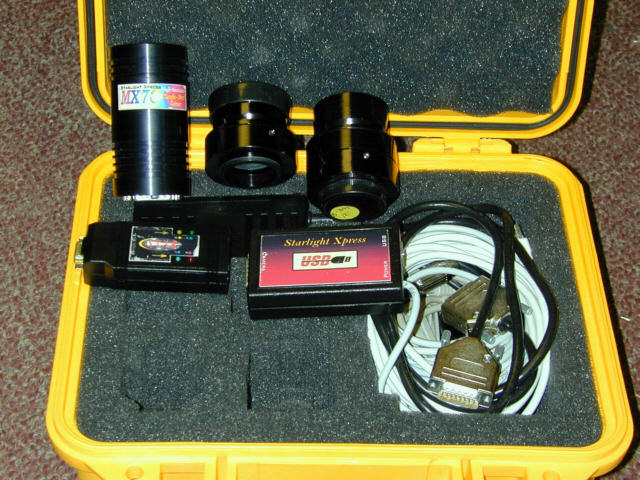 |
Starlight Xpress MX7C one shot color camera with all accessories in
Pelican carrying case. Visible from top left are: MX7C Camera, Optec 2"
3x focal reducer, Optec 2" 2x focal reducer, 12/120V power supply, Star2000
autoguiding controller, USB camera interface, and far too many coiled
cables. In spite of its relative simplicity, this camera actually takes
very good pictures. It utilizes a Sony interline CCD chip, which has a
unique electron capture system that yields both a very low dark current and
anti-bloom characteristics without a reduction in sensitivity. The
individual pixels are colored with a patterned mosaic of cyan, magenta,
yellow, and green filters. A small amount of cleverly applied arithmetic
yields both a high resolution luminance image and a set of lower resolution
RGB images. The color frames are, of course, always properly aligned with
the luminance frame. Full screen image Full size image (1600x1200) |
 |
SBIG STV universal camera, autoguider, and general purpose diagnostic
tool. Although its low pixel count renders it a rather mediocre astronomy
camera, this versatile device it is absolutely great at all the rest of its
functions. As a stand alone autoguider, it is about the best on the market.
In another of its modes, it can quickly give you numerical readout of both
seeing and transparency. It can also be used to track the drift of a star
for precise polar alignment. While doing a drift analysis, it will also
display a graph of your scope's unguided periodic tracking error. Full screen image Full size image (1600x1200) |
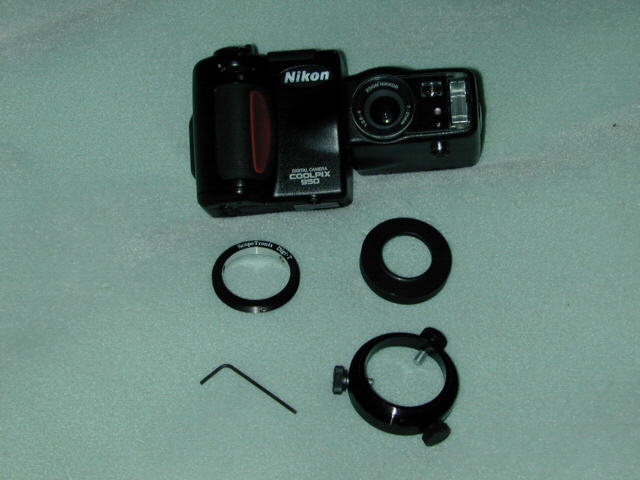 |
Nikon CoolPix 950 2-megapixel digital camera for afocal imaging. Also
shown are the Scoptronics Digi-T adapters. These devices are used in pairs,
one for the camera, and one for the eyepiece. The camera adapter screws
onto the filter threads and converts them to "female" T threads. These
adapters are camera specific. The eyepiece adapter grabs onto the top of an
eyepiece and converts it to "male" T threads. This is a universal adapter
that will fit any eyepiece. To attach to an eyepiece, the rubber eye cup is
first removed, then the adapter is put in place where the eyecup was. A set
of three set screws lock into the eye cup ring. The two devices then screw
together for consistent, reliable, and well collimated images. Full screen image Full size image (1600x1200) |